

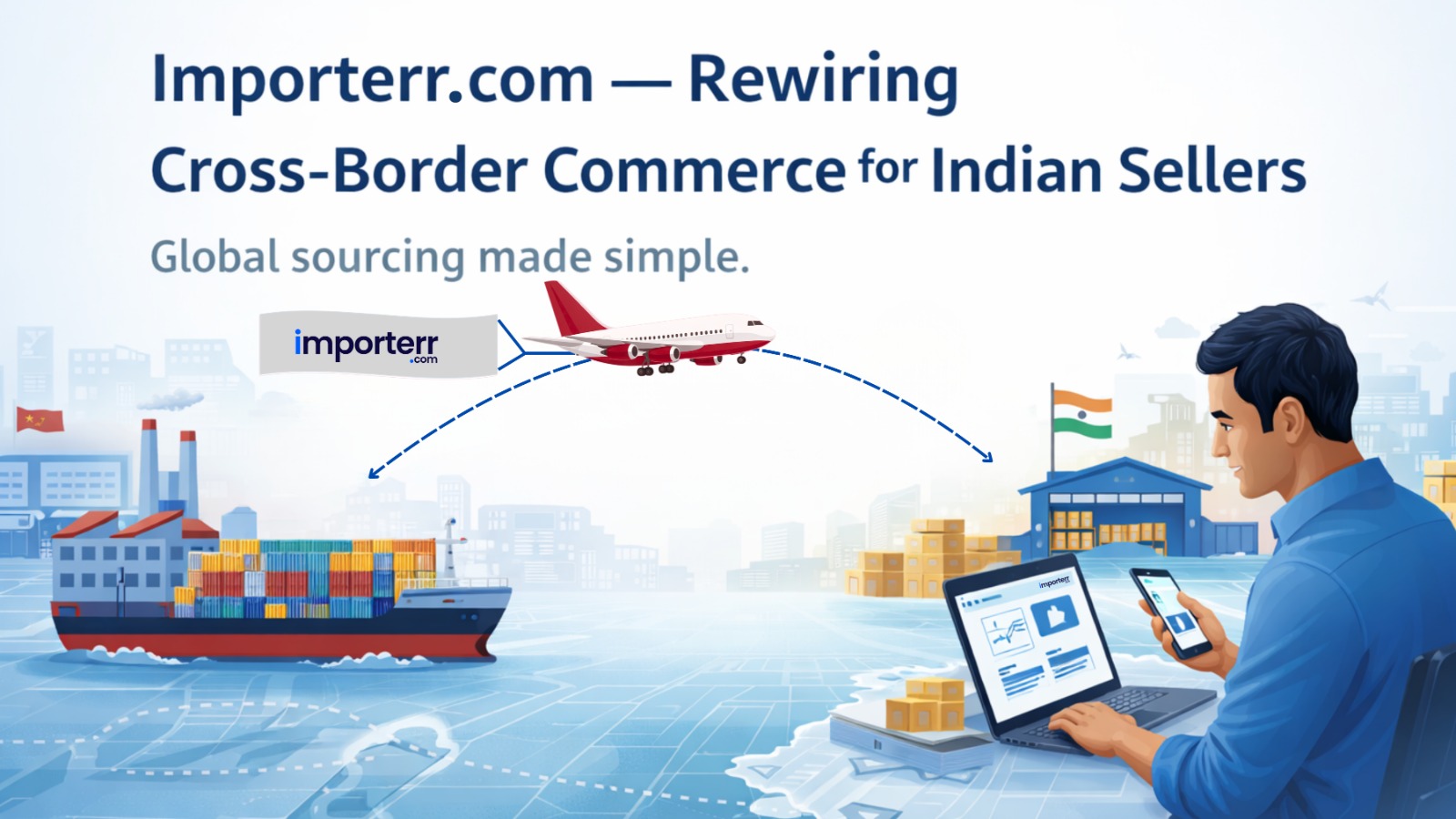
India’s online retail market keeps adding new ecommerce sellers, but global sourcing still stays out of reach for most of them. Students, home-based sellers, small traders, and early-stage brand founders often face the same barriers. Chinese factories ask for large orders. Prices change during talks. Language gaps slow deals. Quality remains uncertain. Customs, compliance, and cross-border payments add more risk. For many, importing still feels like a game meant for firms with deep pockets.
Importerr.com is trying to change that structure. The company presents itself not as a simple sourcing tool, but as a vertically integrated, end-to-end cross-border sourcing and fulfillment platform. Its pitch is clear: let Indian sellers source from China, sell in India, and scale up without bulk buying, without supplier calls, and without handling import complexity on their own.
Importerr strengthens trust in cross-border trade through over 15 years of cross-border import experience and its own warehouses in China. With on-ground operations and quality checks conducted before dispatch, the platform provides structured, compliant, and accountable sourcing support for Indian sellers.
Who the platform is built for
Importerr targets a wide set of users who sit outside large import houses. This includes students and side-hustlers testing online stores, dropshippers, housewives running home-based businesses, and sellers on Amazon, Flipkart, and Meesho. It also serves B2B traders and wholesalers who need steady supply, along with brand founders and private-label sellers who want control over sourcing.
What links these groups is the same need. They want access to global factories, but they do not want to block large sums of money or deal with cross-border friction. Importerr’s model focuses on that gap.
From sourcing tool to full-stack platform
Most solutions in this space work in parts. Some firms act as sourcing agents. Others handle freight or customs. Dropshipping catalogs solve only the front end. Importerr brings these steps into one system.
Through a single dashboard, sellers can find products, place orders, and sell through either dropshipping or inventory-based models. The company manages supplier coordination, basic quality checks in China, packing, export documents, customs clearance, compliance, cross-border payments, Indian warehousing, and last-mile delivery. In effect, the platform covers the full chain from factory to Indian customer.
This structure matters because it changes how risk sits with the seller. Instead of managing multiple middlemen across two countries, users work inside one operational flow.
The role of AI in product discovery
A key part of Importerr’s positioning is its tech layer. The platform describes itself as AI-enabled and tech-driven, not a manual sourcing service. Sellers can use image-based product search to find matching or similar items from factories in China. The system also supports faster product discovery and matching, which helps reduce the time between spotting a trend and listing a product.
By using AI tools for search and product mapping, Importerr.com aims to help sellers who do not have sourcing experience. The idea is to shorten research time, cut trial and error, and move products to market faster.
Small orders, wholesale pricing
One of the platform’s main features is its 1 MOQ model. In practical terms, this means a seller can order even a single unit at a pre-set wholesale rate. The pricing is pre-negotiated by Importerr, so users get bulk pricing benefits without making bulk purchases.
This also removes the need for supplier negotiation. Sellers do not need to speak with factories, deal with language barriers, or bargain over price. Importerr handles those steps. For many first-time sellers, this removes one of the biggest entry hurdles to global sourcing.
Why dropshipping and asset-light models matter
The platform supports both dropshipping and low-inventory selling. A seller can list products, take orders, and let Importerr handle storage and dispatch. This allows for asset-light operations, where users do not need to hold stock upfront.
For small teams, this model lowers risk. Products can be tested in the market before any large purchase. If demand stays weak, the seller can move on without sitting on unsold goods.
Capital efficiency with real numbers
Bulk imports often require ₹10 lakh to ₹50 lakh or more locked into stock. For many MSMEs and first-time founders, that level of risk is not practical. Importerr’s structure aims to avoid that trap. By allowing small orders at wholesale rates and offering dropshipping options, sellers can keep capital free for marketing, content, or new product tests.
This shift in cash use changes how growth happens. Instead of betting big on one shipment, sellers can scale only what sells.
Multi-channel selling support
Importerr is built for sellers who work across platforms. The system supports marketplace-ready workflows, Amazon and Shopify store integration, downloadable listing files, and dropshipping operations. This allows users to sell on Amazon, Flipkart, Meesho, or their own sites without rebuilding their supply chain each time.
For brands, this also means faster expansion across channels, using the same backend for sourcing, tracking and fulfillment.
Beyond reselling: the private label angle
The company also focuses on early-stage founders who want to build their own brand. Instead of offering only generic products, the platform supports brand-focused sourcing models.
Through white-label manufacturing, founders can sell products under their own brand name with customized packaging and branding. With factory access and managed operations, Importerr helps sellers move from simple reselling to structured brand building.
Impact on smaller cities and new founders
E-commerce growth in India no longer stays limited to metros. Sellers from tier two and tier three cities now run online stores on major ecommerce platforms. Many of them lack access to unique and trending products and global supply chains. A system that handles sourcing, compliance, and logistics can give them the same reach as larger firms.
By lowering entry barriers, Importerr may widen the base of sellers who try product-led businesses and brand building.
Limits and execution risks
Cross-border trade always involves risk. Port delays, customs issues, freight fluctuations, and supply disruptions are factors that no single platform can fully control. For Importerr, the real test will be how well it manages scale, quality control, and customer support when challenges arise.
Trust depends on consistent delivery, clear communication, and stable operations across borders. Even small delays or coordination gaps can impact sellers’ margins and customer satisfaction.
When sellers connect directly with factories in China, the process can take two to three months before procurement even starts. It includes supplier verification, sampling, price negotiation, production planning, documentation, compliance checks, payments, and logistics. Managing all this independently is time-consuming and risky, especially for new sellers, and can lead to delays, errors, and blocked capital.
Cross-border sourcing is not just about finding a supplier — it’s about managing the entire process smoothly.
A longer-term infrastructure play
Importerr’s stated ambition goes beyond being a sourcing tool. The company aims to become a sourcing backbone and commerce infrastructure layer for Indian MSMEs. By combining AI-driven discovery, small-order wholesale access, and full-stack fulfillment, it is positioning itself as a bridge between Indian sellers and Chinese manufacturers.
If this model holds, it could shift how small and mid-sized sellers think about importing. Instead of a capital-heavy gamble, global sourcing starts to look like a structured, tech-led workflow that scales with demand.
In a market where speed, margins, and cash control decide survival, that change in approach may shape the next wave of Indian online brands.
