

By a Staff Reporter
ANAND, INDIA – In a sun-drenched living room in Surat, 32-year-old Meera Ben manages her household finances with the precision of a seasoned accountant. She holds a Bachelor’s degree in Gujarati Literature. She has a sharp, persuasive wit. Yet for six years, her resume has languished in the digital abyss.
Every time she tries to re-enter the workforce, she hits the same wall: the English language.
Meera is articulate, intelligent, digitally literate. But in corporate India’s eyes, she’s “unemployable” because she can’t navigate a client call in fluent, corporate English.
Her story is the silent tragedy of India’s digital revolution. High-speed internet has reached Tier-2 and Tier-3 cities, but the economic opportunities that come with it remain locked behind a linguistic gatekeeper. Millions of educated women in Patna, Indore, Madurai, and Gorakhpur are barred from remote work because the interface of employment is English.
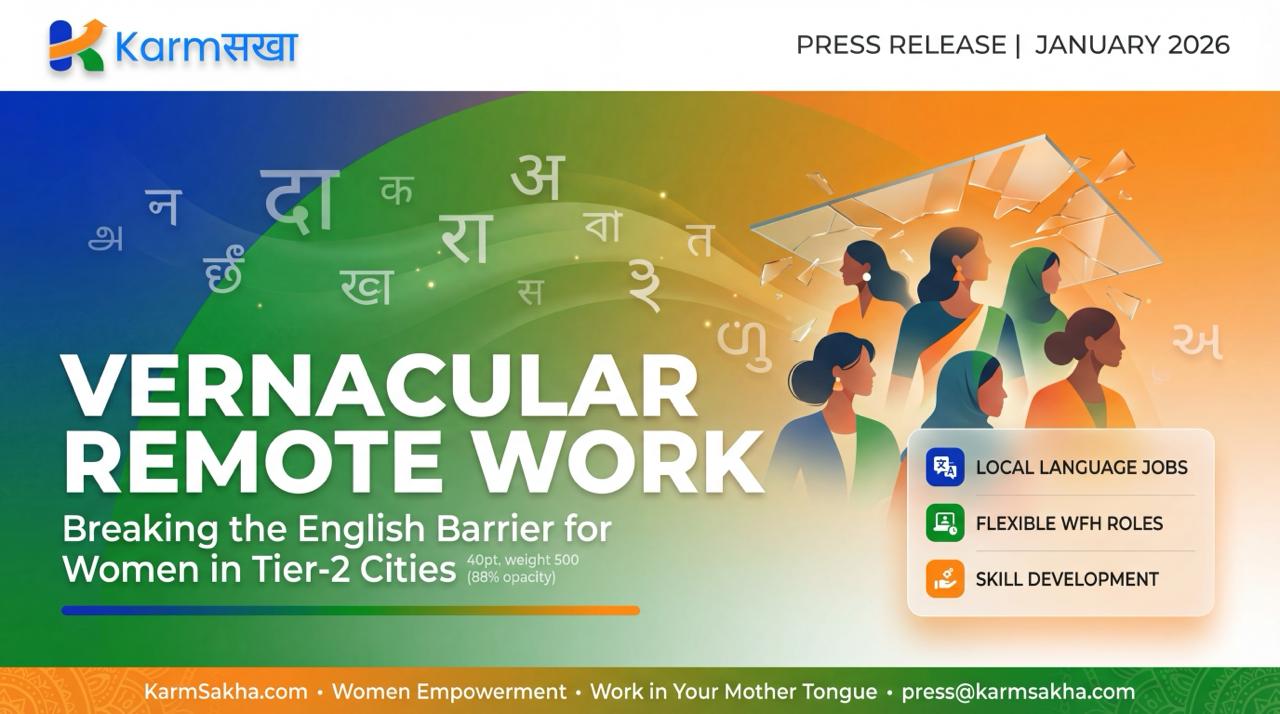
This week, KarmSakha.com shattered this “English Glass Ceiling” with the launch of its pioneering ‘Vernacular Remote Work’ portal—a first-of-its-kind section offering white-collar remote jobs that prioritize proficiency in Indian mother tongues over English.
The “Language Apartheid” in Recruitment
“For too long, we’ve confused ‘communication skills’ with ‘English fluency’,” says Rajesh Patel, CEO of KarmSakha. “We’re sitting on a goldmine of talent that’s being ignored. Women who can sell ice in the desert using Marwari or Punjabi get rejected because they can’t write corporate emails in English. This is an artificial barrier that makes no economic sense in 2026.”
The timing is perfect. As digital penetration saturates metros, the next wave of growth for Fintech, EdTech, and E-commerce is coming from ‘Bharat’—rural and semi-urban India. These customers don’t speak English. So companies no longer need English speakers; they need cultural translators.
Monetizing the Mother Tongue
The portal’s interface is radically different. Candidates create video resumes in their native language. The three core verticals:
?️ Hindi & Regional Voice Support: A farmer in Vidarbha calling about a tractor loan feels comfortable speaking to someone in his Marathi dialect. KarmSakha lists over 5,000 vacancies where women work from home as ‘Voice Partners,’ resolving queries with empathy no bot can match.
✍️ Regional Content Writing: With vernacular news apps and OTT platforms exploding, there’s hunger for content in Indian languages. The portal connects women with degrees in literature to agencies needing blog posts, video scripts, and product descriptions in Bengali, Tamil, Malayalam.
? Local Telesales: “Trust is the currency of sales.” A woman in Vadodara is far more likely to convince a local shopkeeper to adopt QR payments if she speaks Gujarati. Women act as digital sales agents for major brands within their own linguistic geography.
The “Digital Vyavahar” Initiative
Language isn’t the only hurdle. KarmSakha introduced a mandatory bridge course: “Digital Vyavahar” (Digital Etiquette). This short, vernacular-language module teaches remote work basics—using CRM tools on phones, logging hours, professional conduct—ensuring job-readiness without needing English.
Empowerment Without Migration
For Suman Tiwari, a 28-year-old sociology graduate from Patna, this is a lifeline. “I always wanted to work, but my family was hesitant about me migrating to Delhi, and I was hesitant about my English,” she shares.
Suman secured a role as ‘Relationship Manager’ for a Hindi-medium online tuition platform through the Vernacular Remote Work portal.
“Now I work four hours a day from my bedroom. I speak to parents in Hindi, explaining how the app works. I understand their worries because I’m a mother too. For the first time, my language is my strength, not my weakness. When I earned my first ₹15,000, I didn’t just buy gifts for my son—I bought respect for myself.”
A New Definition of Professionalism
As the first batch of thousands of women log in to the portal today, the message is clear: Professionalism is about competence, reliability, and results. It’s not about the language you speak.
By validating the economic worth of Indian languages, KarmSakha is doing more than providing jobs—it’s restoring dignity. It tells the woman in the saree in a middle-class home in Surat or Siliguri: You don’t need to change who you are to be part of the future. Your voice, just as it is, is ready for business.
